Many people use the terms CV, resume, and biodata interchangeably, but they are actually different documents used for different purposes. Understanding the difference between them is important, especially when applying for jobs, higher studies, or even marriage.
In this guide, we’ll clearly explain what each document means, when to use it, and how they differ from each other.
What is a CV (Curriculum Vitae)?
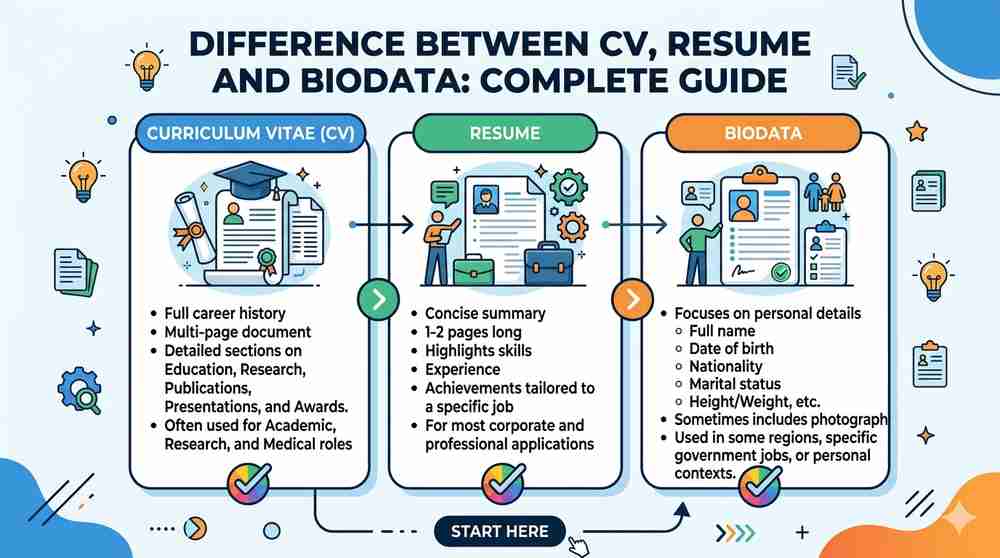
A CV (Curriculum Vitae) is a detailed document that provides a complete overview of your academic and professional history.
Key Features of a CV:
- Full form: Curriculum Vitae (Latin for “course of life”)
- Length: 2–5 pages (or more)
- Includes detailed academic background
- Lists research work, publications, certifications, and achievements
- Mostly used for academic, research, and international job applications
When to Use a CV:
- Applying for higher education (Master’s, PhD)
- Academic or teaching positions
- Research roles
- Jobs abroad (especially in Europe)
What is a Resume?
A resume is a short and concise document that highlights your skills, experience, and qualifications relevant to a specific job.
Key Features of a Resume:
- Length: 1–2 pages
- Focused on skills and work experience
- Tailored for each job application
- Uses bullet points for clarity
- Quick and easy to scan
When to Use a Resume:
- Applying for private sector jobs
- Corporate roles
- Internships
- Entry-level or experienced job applications
What is Biodata?
Biodata (short for biographical data) is a document that includes personal and family details along with basic professional information.
Key Features of Biodata:
- Includes personal details (age, gender, religion, marital status)
- Contains family background information
- Used in both job applications (in some countries) and marriage proposals
- Often includes hobbies and personal traits
When to Use Biodata:
- Marriage proposals (matrimonial biodata)
- Government job applications (in some regions)
- Traditional or formal documentation
Key Differences Between CV, Resume and Biodata
Feature | CV | Resume | Biodata |
|---|---|---|---|
Full Form | Curriculum Vitae | Resume | Biographical Data |
Length | Long (2–5+ pages) | Short (1–2 pages) | Varies |
Focus | Academic & career history | Skills & experience | Personal & family details |
Purpose | Academic, research, abroad jobs | Corporate jobs | Marriage or formal use |
Personal Details | Minimal | Minimal | Detailed |
Customization | Rarely changes | Tailored for each job | Usually fixed |
CV vs Resume vs Biodata: Simple Explanation
- CV = Detailed academic and career history
- Resume = Short summary for job applications
- Biodata = Personal + family information
Think of it this way:
- CV is detailed
- Resume is focused
- Biodata is personal
Which One Should You Use?
Choosing the right document depends on your purpose:
Use CV if:
- You’re applying for academic or research roles
- You need to show detailed qualifications
Use Resume if:
- You’re applying for jobs in companies
- You want to highlight skills and experience
Use Biodata if:
- You’re creating a marriage profile
- You need to provide personal and family details
Tips for Choosing the Right Format
- Always check what the employer or platform asks for
- Don’t use biodata for corporate jobs unless requested
- Customize your resume for every job
- Keep CV updated with achievements
- Use biodata mainly for matrimonial or traditional purposes
Common Mistakes to Avoid
1. Using the Wrong Format
Don’t send biodata instead of a resume for a job application.
2. Adding Too Much Personal Information
Avoid unnecessary personal details in resumes and CVs.
3. Not Customizing Resume
Sending the same resume to every job reduces your chances.
4. Making It Too Long
Keep resume short and CV relevant.
5. Poor Formatting
Use clean structure and readable fonts.
CV, Resume and Biodata in India
In India, all three formats are commonly used:
- Resume – Most popular for private jobs
- CV – Used in academia and teaching jobs
- Biodata – Widely used for marriage and government forms
Understanding their differences helps you present yourself correctly in different situations.
Conclusion on CV, Resume and Biodata
CV, resume, and biodata may look similar, but they serve very different purposes. A CV gives a detailed view of your academic journey, a resume highlights your professional skills, and biodata focuses on personal and family information.
Choosing the right format can improve your chances of success—whether you're applying for a job, pursuing higher studies, or creating a marriage profile.
Always match your document to your purpose, keep it clear and well-structured, and present your information honestly.
FAQs on CV, Resume and Biodata
1. What is the main difference between a CV, resume, and biodata?
A CV is a detailed academic and professional document, a resume is a short summary for jobs, and biodata includes personal and family details.
2. Which is better: CV or resume?
Neither is better—it depends on the purpose. Use a CV for academic roles and a resume for corporate jobs.
3. Is biodata the same as a resume?
No, biodata includes personal and family information, while a resume focuses on skills and professional experience.
4. Can I use a CV instead of a resume?
Yes, but only if the employer accepts it. Many companies prefer a resume because it is shorter and more focused.
5. Where is biodata commonly used?
Biodata is commonly used for marriage proposals, government forms, and traditional applications.
6. How long should a CV be?
A CV can be 2–5 pages or more, depending on your experience and achievements.
7. How long should a resume be?
A resume should ideally be 1–2 pages, concise and tailored to the job.
8. Should I include personal details in a resume or CV?
Only basic details like name and contact information should be included. Avoid unnecessary personal information.
9. Can I customize my resume for different jobs?
Yes, and you should. Tailoring your resume for each job increases your chances of getting selected.
10. Is biodata still relevant today?
Yes, especially for matrimonial purposes and certain traditional or government uses.